
 September 17, 2026
 No Comments
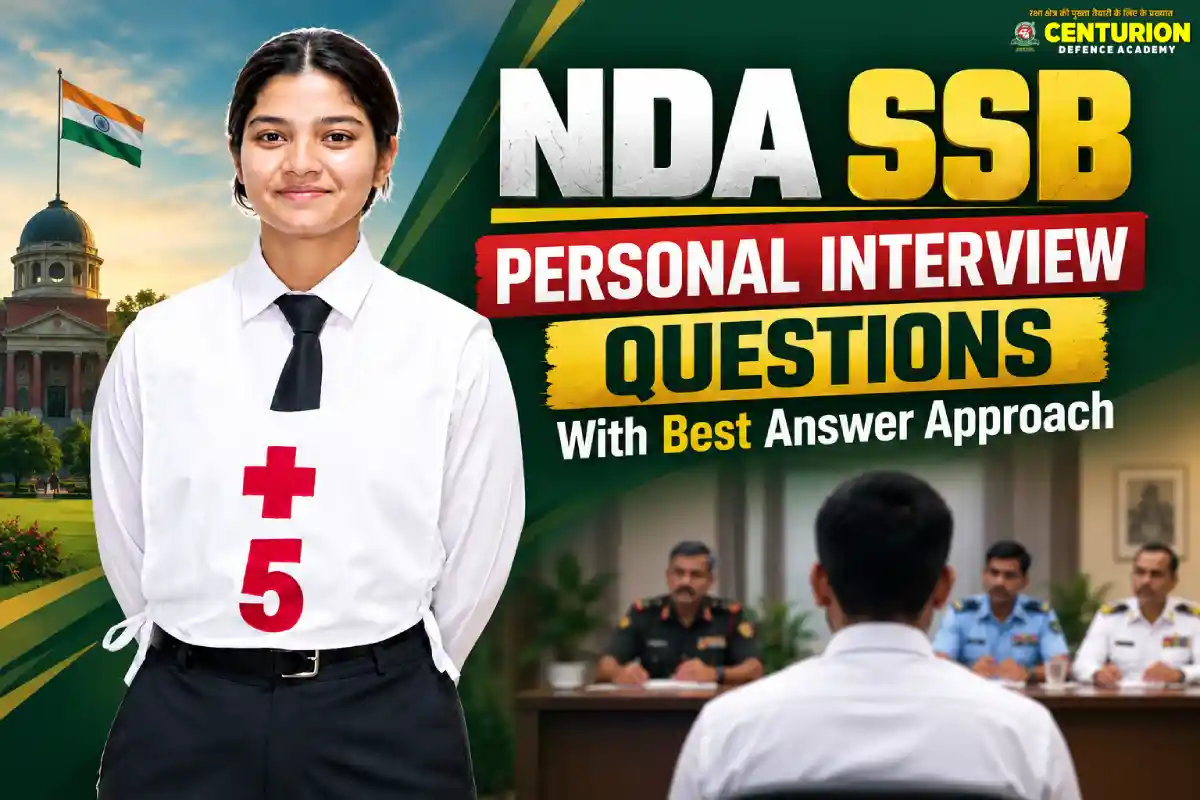
NDA SSB Personal Interview Questions with Best Answer Approach
Clearing the NDA written examination is a major milestone for any defence aspirant. But after the written exam, there is another important stage waiting for you: the SSB Interview.
And this is where many aspirants start thinking, “What exactly will they ask me?”
The truth is that there is no fixed list of NDA SSB Personal Interview Questions that every candidate will face. The Interviewing Officer (IO) can ask questions based on your PIQ form, academics, family, hobbies, friends, achievements, failures, daily routine, current affairs, defence awareness, and motivation to join the Armed Forces.
This is why simply memorising 50 or 100 SSB interview answers is not the best way to prepare.
Instead, you should understand the approach behind answering SSB interview questions.
The SSB assessment is not only about how much you know. It also looks at how you think, communicate, respond to situations, and present your personality. The interview is conducted as part of Stage II of the SSB process along with GTO tasks, Psychology Tests, and Conference. UPSC states that candidates are assessed holistically through these techniques for Officer Like Qualities and their trainability.
So, how should you prepare?
Let’s understand it through some of the most important NDA SSB Personal Interview Questions with the best answer approach.
How to Answer Questions in the NDA SSB Interview?
Before getting into the questions, remember one simple rule:
Don’t prepare sentences. Prepare yourself.
Suppose the IO asks:
“Why do you want to join the Armed Forces?”
You can easily find a model answer online and memorise it. But the moment the IO asks:
- When did you develop this interest?
- Who influenced you?
- Why not another career?
- What do you know about military life?
- What have you done to prepare for it?
Your memorised answer may stop helping you.
Instead, understand your own story.
Know why you want this career, what influenced you, what you have done towards your goal, and what you understand about the responsibilities involved.
Your answers should be honest, clear, relevant, and supported by real experiences wherever possible.
20 NDA SSB Personal Interview Questions With Best Answer Approach
1. Tell Me About Yourself
This is often one of the first questions candidates hear during an SSB Personal Interview.
It may look simple, but don’t turn it into a five-minute speech.
The IO doesn’t need your entire biography.
Best Answer Approach
Briefly talk about:
- Your name
- Hometown
- Education
- Hobbies
- Important achievement or responsibility
- Career goal
Sample Answer
“Sir, I am currently studying in Class 12, and I am from Lucknow. I have always been interested in sports and have participated in school-level basketball competitions. Along with my academics, I have been preparing for the NDA examination because I want to build a career as an Armed Forces officer.”
The exact answer should be based on your own background.
Remember
Anything you mention can become the next question.
If you say you play basketball, the IO may ask about your position, favourite player, rules, or recent tournaments.
So, don’t mention something just because it sounds impressive.
2. Why Do You Want to Join the Armed Forces?
This is one of the most important questions in NDA SSB interview preparation.
Many candidates immediately answer:
“Sir, I want to serve the nation.”
There is nothing wrong with this answer, but it doesn’t tell the IO much about your personal motivation.
Best Answer Approach
Think about:
- When your interest started
- Who or what influenced you
- What attracts you to military life
- What you understand about the profession
- What you have done to explore this career
Sample Answer
“Sir, my interest in the Armed Forces developed during my school years when I got an opportunity to learn more about military life and leadership. I like the combination of responsibility, teamwork, and discipline that comes with the profession. Over time, I realised that I would like to take up a career where I can work with people, take responsibility, and contribute to the country.”
Your reason may be completely different.
Maybe your interest came from NCC.
Maybe a family member influenced you.
Maybe you became interested after watching a parade.
Maybe your interest developed through sports.
Use your own story.
3. Why Do You Want to Join NDA?
The IO may want to know whether you have actually researched the career you are preparing for.
NDA is not simply another college admission.
It is an institution where cadets from the Army, Navy, and Air Force undergo joint training before moving on to further service-specific training.
Best Answer Approach
Connect NDA with your long-term career goal.
Sample Answer
“Sir, I want to join NDA because it provides an opportunity to undergo joint training with cadets of the Army, Navy, and Air Force. I believe that this environment will help me develop academically, physically, and as a team member before taking up further military training.”
Follow-up Questions You Should Prepare
The IO may ask:
- What do you know about NDA?
- Where is NDA located?
- When was it established?
- What is the motto of NDA?
- What happens after NDA training?
- Why NDA instead of another graduation route?
So don’t prepare only one answer.
4. Why Do You Want to Become an Officer?
This question is slightly different from “Why do you want to join the Armed Forces?”
Here, you should demonstrate that you understand the responsibility of leadership.
Best Answer Approach
Talk about:
- Responsibility
- Leadership
- Decision-making
- Teamwork
- Accountability
Sample Answer
“Sir, I am attracted to the responsibility that comes with being an officer. I want to work in a team, make decisions when required, and be responsible for both the task and the people working with me. I understand that leadership also means being accountable for my decisions.”
Avoid answers based mainly on:
- Status
- Uniform
- Power
- Respect
- Salary
These may be associated with the profession, but they shouldn’t be the entire reason behind your motivation.
5. Why Have You Chosen the Army, Navy or Air Force?
If you have a preference for a particular service, be prepared to explain it.
For example, if you say you want to join the Air Force because you love aircraft, the IO may ask:
- Which aircraft do you like?
- Why?
- What are the different types of aircraft?
- What is the role of the Air Force?
- Why Air Force and not Army?
- What do you know about the service?
Best Answer Approach
Use:
Interest + Awareness + Personal Connection + Career Understanding
Sample Answer
“Sir, I am interested in the Indian Air Force because I have been fascinated by aviation for a long time. I also like the combination of technology, teamwork, and operational responsibility involved in the service. I have been trying to understand the role of the Air Force beyond just aircraft and flying.”
The answer should reflect your genuine preference.
6. What Are Your Strengths?
This question is easy to answer badly.
If you simply say:
“I am hardworking, honest, confident, and disciplined.”
The IO may immediately ask:
“Give me an example.”
Now you need evidence.
Best Answer Approach
Choose two or three genuine strengths and connect them with real situations.
Sample Answer
“Sir, I consider taking responsibility and staying consistent among my strengths. For example, during a school event, I was given responsibility for coordinating a group of students. There were some last-minute problems, but I divided the work and made sure that we completed it on time.”
The example is more important than the adjective.
Don’t just say:
“I am a good leader.”
Explain when you actually took responsibility.
7. What Is Your Weakness?
This is a classic SSB Personal Interview question.
One of the most common mistakes is answering:
“Sir, I don’t have any weakness.”
Everyone has areas that can be improved.
Best Answer Approach
Use this structure:
Weakness → Example → Improvement
Sample Answer
“Sir, sometimes I spend more time than necessary checking my work because I want to avoid mistakes. I realised that this can affect my time management, so now I set a specific time limit for reviewing my work.”
This shows that you:
- Know yourself
- Accept your limitations
- Are working on improvement
Don’t give a fake weakness such as:
“I am too perfect.”
The IO may cross-question you.
8. Who Is Your Role Model and Why?
There is no compulsory answer to this question.
Your role model could be:
- Parent
- Teacher
- Armed Forces officer
- Sportsperson
- Scientist
- Entrepreneur
- Social worker
- Any person who genuinely influenced you
Best Answer Approach
Explain:
Who → What quality → How it influenced you
Sample Answer
“Sir, my father is one of my role models because of his sense of responsibility. I have seen him continue working calmly even when things are difficult. From him, I have learned that responsibility does not depend on whether the situation is convenient or not.”
Possible Follow-up
The IO may ask:
“What have you actually learned from him?”
So don’t simply memorise a personality’s biography.
Talk about the actual influence.
9. Tell Me About Your Family
This question may sound basic, but the IO can ask several follow-up questions.
Best Answer Approach
Keep it simple and factual.
Talk about:
- Number of family members
- Parents
- Their occupation
- Siblings
- Family environment
- Values you have learned
Sample Answer
“Sir, there are four members in my family: my parents, my younger sister, and me. My father works in the private sector, and my mother is a teacher. My sister is currently studying in school. We spend a lot of time together, and my parents have always encouraged me to take responsibility for my decisions.”
Be Prepared For
- What does your father do?
- What does your mother teach?
- What is your sibling studying?
- Who are you closer to?
- What do you do together as a family?
- What values have you learned from your parents?
Know your family well.
10. Who Is Your Best Friend and Why?
The IO may use this question to understand your social relationships.
Don’t just name someone and stop.
Best Answer Approach
Talk about:
- How long you have known the person
- What you like about them
- What you do together
- What you have learned from the friendship
Sample Answer
“Sir, my best friend is one of my classmates. We have known each other for several years. I like his reliability and that he gives me an honest opinion, even when I may not agree with him. We also play sports together, so we have learned to work as a team.”
Possible Follow-up Questions
- What are his strengths?
- What are his weaknesses?
- What do you dislike about him?
- Have you ever argued?
- How did you resolve it?
Be realistic.
Don’t say your best friend has no weaknesses.
11. What Are Your Hobbies?
This question can become a long conversation.
So be careful about what you write in your PIQ.
Best Answer Approach
Mention hobbies that you genuinely pursue.
Sample Answer
“Sir, I enjoy playing cricket and reading non-fiction books. I usually play cricket with my friends in the evening, and I mostly read books related to history and biographies.”
Now be prepared for:
If you say cricket:
- Which position do you play?
- Who is your favourite player?
- Which team do you support?
- What are the basic rules?
- Which tournament are you following?
If you say reading:
- Which book did you read recently?
- Who wrote it?
- What was it about?
- What did you learn from it?
- Golden Rule
Don’t write a hobby just because it sounds impressive.
If you don’t actually do it, the IO may quickly find out.
12. Why Are Your Marks Low in a Particular Subject?
If you have a weak academic area, don’t panic.
The IO is not necessarily looking for a perfect academic record.
What matters is whether you understand your performance and take responsibility for it.
Best Answer Approach
Avoid blaming:
- Teacher
- School
- Parents
- Friends
- Examination
- Luck
Explain the genuine reason and what you did afterwards.
Sample Answer
“Sir, Mathematics was one of my weaker subjects in Class 11 because I did not practise regularly and focused more on the subjects I was comfortable with. I realised my mistake and started solving questions consistently. My performance improved after I changed my approach.”
This shows self-awareness and improvement.
13. What Is Your Daily Routine?
Don’t create an unrealistic routine just to impress the IO.
If you normally wake up at 6:30 AM, don’t claim that you wake up at 4 AM every day.
Best Answer Approach
Talk about your actual:
- Study schedule
- School/college
- NDA preparation
- Physical activity
- Hobbies
- Family time
- Sleep
Sample Answer
“Sir, I generally start my day with some physical activity. After school, I spend time on my NDA preparation and complete my academic work. In the evening, I usually play sports or exercise, and I keep some time for reading or revision. I try to maintain a fixed sleep schedule as well.”
Remember
The IO can ask:
“What did you do yesterday?”
Your answer should be consistent with your routine.
14. What Have You Learned From Sports?
If you play a sport, the IO may want to know what it has actually taught you.
Don’t simply list:
“Teamwork, leadership, discipline, confidence and decision-making.”
Choose one or two qualities and explain them through experience.
Sample Answer
“Sir, sports have mainly taught me teamwork and how to handle both success and failure. There have been matches where we lost despite preparing well. I learned that instead of blaming one person, the team should analyse what went wrong and improve before the next match.”
This sounds more genuine because it comes from an experience.
15. Tell Me About One Failure You Have Faced.
Don’t be afraid of this question.
You don’t have to present yourself as someone who has never failed.
Best Answer Approach
Use:
Situation → Mistake → Learning → Improvement
Sample Answer
“Sir, I performed poorly in one of my school examinations because I started preparing too late. Initially, I thought I could cover everything in the last few days, but that did not work. After that, I started dividing the syllabus into weekly targets and reviewing my preparation regularly. It helped me become more consistent.”
The important part is not the failure itself.
It is what you learned from it.
16. What Is Your Biggest Achievement?
Your biggest achievement doesn’t have to be a national-level medal.
It could be:
- Winning a school competition
- Improving your academic performance
- Leading a team
- Completing a difficult project
- Participating in NCC
- Helping organise an event
- Overcoming a personal challenge
Sample Answer
“Sir, one achievement I am proud of is winning an inter-school basketball competition with my team. I was responsible for coordinating some of the players during the tournament. More than the trophy, I value the experience because it taught me how important communication and teamwork are.”
Be Ready For
The IO may ask:
- What exactly did you do?
- How many teams participated?
- What was your responsibility?
- What problems did you face?
So know the details.
17. What Do You Know About Your Hometown?
This is an important area of NDA SSB Interview preparation.
You don’t need to memorise a Wikipedia page.
But you should know your hometown.
Prepare These Areas
- Location
- History
- Geography
- Famous personalities
- Important places
- Culture
- Economy
- Major industries
- Education
- Current developments
- Major local issues
Sample Answer
“Sir, I am from Lucknow, the capital of Uttar Pradesh. It is known for its historical heritage, Awadhi culture, and cuisine. The city also has important educational, administrative, and defence-related institutions. I have lived there for most of my life, so I am also familiar with some of the major issues the city faces, such as traffic and urban development.
If you are from a village or small town, the same rule applies.
Know your place.
18. What Are You Currently Following in Current Affairs?
Current affairs are an important part of SSB interview preparation.
But don’t try to memorise every headline.
Choose topics you actually understand.
Sample Answer
“Sir, I have been following recent developments in India’s defence sector, particularly the increasing focus on indigenous defence production. I find it important because developing domestic capabilities can reduce dependence on imports and also strengthen India’s defence manufacturing ecosystem.”
The IO can then ask:
- Why is this important?
- What are the challenges?
- What is your opinion?
- Which recent development have you followed?
- How does it affect India?
Best Approach
For every important current affair, try to understand:
What happened? → Why did it happen? → Why does it matter? → What is your understanding?
This is much more useful than simply memorising headlines.
19. What Will You Do If You Are Not Recommended in SSB?
This question checks how you respond to disappointment.
Don’t say:
“Sir, I will never give up.”
That’s positive, but it doesn’t tell the IO what you will actually do.
Best Answer Approach
Show a practical plan.
Sample Answer
“Sir, obviously I would be disappointed, but I would try to understand where I need improvement. I would work on those areas and prepare again if I am eligible for another attempt. At the same time, I would continue my education and keep an alternative career plan.”
This shows ambition along with practicality.
20. Why Should We Select You?
This question can make candidates nervous because they feel they have to prove that they are better than everyone else.
You don’t.
Best Answer Approach
Talk about your genuine qualities, preparation and willingness to learn.
Sample Answer
“Sir, I believe I have a genuine interest in the Armed Forces, and I have been working consistently towards this goal. I am comfortable working in a team, I take responsibility for my work, and I am willing to learn from my mistakes. I also understand that I still have areas to improve, and I am ready to work on them.”
Don’t say:
“I am better than the other candidates.”
The SSB is not about giving yourself a ranking.
Focus on knowing yourself and presenting yourself honestly.

How Centurion Defence Academy Can Help With SSB Preparation
Knowing common NDA SSB Personal Interview Questions is only the first step. The bigger challenge is learning how to respond naturally when the questions become personalised and the IO starts cross-questioning you.
This is where structured practice can make a difference.
Centurion Defence Academy provides dedicated SSB Interview preparation with exposure to the major components of the selection process, including Screening, Psychology, GTO, and Personal Interview.
The focus is not simply on giving students a list of questions to memorise. Aspirants can work on understanding the SSB process, practising different situations, and improving their overall interview approach.
What You Can Work On During SSB Preparation
At Centurion, aspirants can focus on areas such as:
- SSB Screening preparation
- OIR practice
- PP&DT practice
- Psychology Test preparation
- TAT, WAT, and SRT practice
- GTO task preparation
- Personal Interview practice
- PIQ-based questions
- Mock Interviews
- Communication and confidence
- Individual feedback
- Personality development
The Personal Interview becomes much easier to handle when you have already practised answering questions about your own academics, family, hobbies, achievements, failures, and future goals.
The idea is simple:
Understand the process. Practise the activities. Learn from feedback. Improve your approach.
Why Mock Interviews Matter in SSB Preparation
Reading SSB interview questions and answers can help you understand the type of questions you may face.
But reading and actually sitting in front of an interviewer are two very different experiences.
During a mock interview, you may realise that:
- You speak too quickly.
- Your answers are too long.
- You repeat the same words.
- You struggle with follow-up questions.
- You aren’t confident about your own PIQ.
- You don’t know enough about your hobbies.
- You become nervous when questioned repeatedly.
That is exactly why mock interviews and feedback can be useful.
At Centurion Defence Academy, aspirants preparing for SSB can practise the interview environment and work on their responses with structured guidance.
The objective should not be to make every candidate give the same answer.
It should be to help each aspirant understand their own profile and communicate it better.
How to Prepare the Best Answers for NDA SSB Interview Questions
The biggest mistake aspirants make is trying to memorise answers word-for-word.
The SSB Personal Interview is not a written examination.
The IO can take the conversation in a completely different direction based on your response.
For example:
IO: What is your hobby?
You: Reading.
IO: Which book did you read recently?
You: [Answer]
IO: What did you learn from it?
You: [Answer]
IO: Would you recommend it to your friends?
This is why you should prepare the topic, not the sentence.
Before your SSB interview, sit down and make notes about yourself.
Know Your:
- Family
- School
- Academic performance
- Hobbies
- Friends
- Achievements
- Failures
- Strengths
- Weaknesses
- Daily routine
- Hometown
- Career goals
- NDA motivation
- Service preference
- Current affairs
- Defence awareness
Once you know these areas, you will be much more comfortable handling unexpected questions.
What If You Don't Know the Answer?
This is one of the most important things to understand during SSB interview preparation.
You are not expected to know everything.
If you don’t know the answer, don’t make something up.
Simply say:
“Sir/Ma’am, I don’t know the answer.”
If you know part of the answer but aren’t completely sure, you can say:
“Sir, I am not completely sure, but I believe…”
Being honest is much better than confidently giving incorrect information.
Common Mistakes to Avoid in SSB Personal Interview
1. Memorising Answers
The IO can ask follow-up questions.
2. Bluffing
Don’t pretend to know something you don’t.
3. Giving Very Long Answers
Answer the question and stop.
4. Trying to Look Perfect
You don’t need to prove that you have no weaknesses.
5. Blaming Others
Take responsibility for your mistakes.
6. Fake Hobbies
Mention only activities you actually pursue.
7. Not Knowing Your PIQ
Anything written in your PIQ can become a question.
8. Ignoring Current Affairs
Stay updated with important national, international, and defence developments.
9. Speaking Without Listening
Listen to the complete question before answering.
10. Trying to Act Like an Officer
Don’t put on an artificial personality.
Be yourself, but be confident, respectful, and responsible.
Final Tips for NDA SSB Personal Interview Preparation
Before appearing for your NDA SSB Interview, make sure you can comfortably talk about yourself.
You should be able to answer questions about:
- Your family
- Your education
- Your school
- Your hometown
- Your hobbies
- Your friends
- Your achievements
- Your failures
- Your strengths
- Your weaknesses
- Your daily routine
- Why NDA
- Why the Armed Forces
- Your preferred service
- Current affairs
- Defence awareness
- Your future plans
And remember one important thing:
You don’t have to know the perfect answer. You have to give a genuine answer that you can explain.
The IO can ask the same question to different candidates, but the best response will naturally be different because every candidate has a different background and experience.
So, don’t prepare to sound like someone else.
Prepare to explain your own story clearly and confidently.
Want to Experience the SSB Process Before Your Actual Interview?

Join 2-DAY SSB BOOT CAMP 2026
Centurion Defence Academy’s 2-Day SSB Boot Camp is designed to give aspirants practical exposure to the different stages of the SSB process, including Screening, Psychology, GTO Tasks and Personal Interview. The boot camp allows candidates to understand how SSB activities are conducted, experience tasks such as OIR, PP&DT, Group Discussion, Lecturette, and GTO activities, and receive guidance on areas where they can improve. Rather than waiting until the SSB date to understand the process, aspirants can use this 2-Day SSB Boot Camp as an opportunity to experience the selection environment and assess their preparation beforehand.
Conclusion
The NDA SSB Personal Interview is not about memorising a list of questions and answers.
Yes, practising common NDA SSB interview questions can help you become comfortable with the interview environment. But the real preparation starts when you understand your own personality, experiences, strengths, weaknesses, interests, and career motivation.
If you say that you want to join the Armed Forces, know why.
If you mention a hobby, actually pursue it.
If you call yourself a team player, remember a real situation where you worked in a team.
If you mention an achievement, know your contribution.
And if you don’t know something, be honest about it.
The goal of SSB interview preparation should not be to create a perfect answer for every possible question.
It should be to become comfortable enough with yourself that even when the IO asks an unexpected question, you can think, respond, and communicate naturally.
Prepare the questions. Understand the approach. But don’t memorise your personality.
Frequently Asked Questions
What are the most common NDA SSB Personal Interview Questions?
Common questions usually cover your PIQ, family, academics, hobbies, friends, achievements, failures, strengths, weaknesses, hometown, current affairs, defence awareness, and your motivation to join the Armed Forces.
Should I memorise NDA SSB interview answers?
No. You should practise important topics and understand your own experiences, but avoid memorising scripted answers. The IO can ask follow-up questions based on your response.
What should I say if I don't know an answer in SSB?
Be honest and say that you don’t know. Guessing or bluffing can create more problems when the IO asks follow-up questions.
What is the most important thing in an SSB Personal Interview?
There is no single “perfect” answer or formula. Candidates should focus on knowing themselves, communicating clearly, staying honest, and demonstrating awareness of their own experiences and responsibilities.
How can I prepare for NDA SSB Interview Questions?
Start with your PIQ and prepare topics related to your family, academics, hobbies, friends, achievements, failures, hometown, current affairs, defence awareness, and your motivation for joining the Armed Forces.
Are SSB interview questions the same for every candidate?
No. The questions can vary significantly because the Interviewing Officer can base the conversation on the candidate’s PIQ, background, responses, and experiences.
Tags
NDA Interview PreparationNDA SSB 2026NDA SSB 2027NDA SSB Interview TipsNDA SSB Personal InterviewOfficer Like QualitiesSSB Answer ApproachSSB Coachingssb coaching in indiaSSB InterviewSSB Interview PreparationSSB Personal InterviewSSB Personal Interview Questionsssb preparationSSB Questions With AnswersRecent Posts
-

NDA & CDS 2027:…
September 18, 2026
-

NDA SSB Personal Interview…
September 17, 2026
-

Top 30 GD &…
September 16, 2026
-

NDA 2 2026 Written…
September 15, 2026
-
NDA-2 2026 Paper Analysis…
September 14, 2026


Leave Comment