OPAM Test in SSB - SSB Interview Preparation Coaching

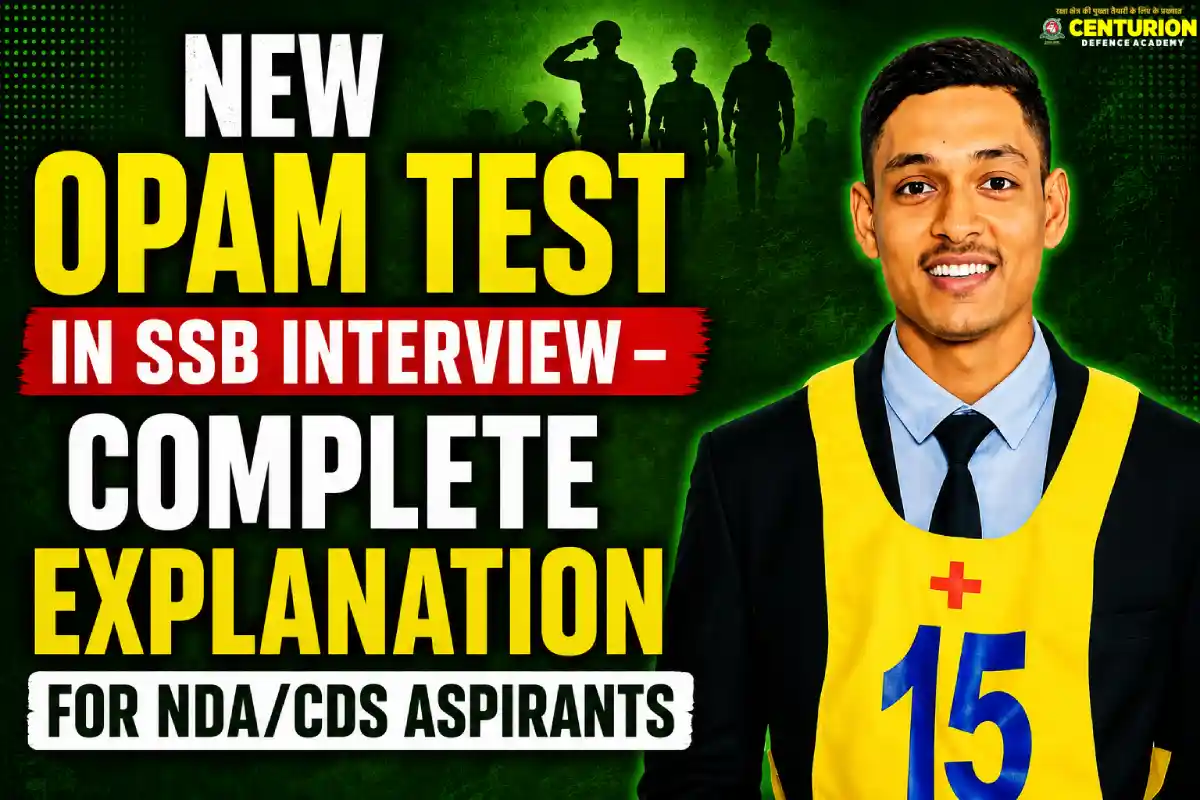
New OPAM Test in SSB Interview – Complete Explanation for NDA/CDS Aspirants

Everything Candidates Must Know About the New SSB Changes

If you’re preparing for NDA, CDS, AFCAT, or any other officer entry in the Armed Forces, you’ve probably come across discussions about major changes in the SSB Interview process.

For years, candidates were familiar with Stage-1 screening through the OIR (Officer Intelligence Rating) Test and PPDT (Picture Perception and Discussion Test). However, the Armed Forces are now moving towards a more technology-driven and objective assessment system.

Under the proposed SSB Interview New Pattern 2026, OIR and PPDT are being replaced by two new computer-based assessments:

  • CSSS (Computerised Stage One Selection System)
  • OPAM (Objective Personality Assessment Measure)
  • Naturally, many aspirants are wondering:
  • What is the OPAM test in SSB?
  • What is CSSS?
  • Why are these changes being introduced?
  • How will they affect NDA and CDS, aspirants?
  • Is the traditional SSB psychology test being removed?

Let’s understand everything in simple language.

What Has Changed in SSB Stage-1?

Traditionally, Stage-1 screening consisted of two tests:

OIR (Officer Intelligence Rating)

This test assessed verbal and non-verbal reasoning abilities.

PPDT (Picture Perception and Discussion Test)

Candidates observed a hazy picture, wrote a story, narrated it to the group, and participated in a group discussion.

The purpose of these tests was to assess intelligence, perception, communication skills, confidence, and officer-like qualities.

However, with changing times and advances in assessment technology, the Armed Forces have introduced a new system that aims to evaluate candidates more scientifically.

Why Has the SSB Selection Process Been Changed?

The new SSB test has been introduced for several important reasons.

1. More Accurate Personality Assessment

Over time, many coaching institutes began training candidates to memorise stories, responses, and discussion techniques.

As a result, assessors sometimes found it difficult to distinguish between a candidate’s real personality and a coached personality.

The new system aims to reduce this gap.

2. Better Use of Technology

Today’s military environment relies heavily on technology and data-driven decision-making.

The selection process is also evolving in the same direction.

3. Objective Evaluation

Computer-based assessments provide standardised testing conditions and help assessors gather more reliable behavioural and cognitive data.

New SSB Stage-1 Pattern 2026: Overview

Component

Old Pattern

New Pattern 

Intelligence Assessment

OIR

CSSS  

Personality Assessment

PPDT 

OPAM 

Mode 

Paper-Based

Computer-Based 

Total Questions

Separate Activities

190 Questions

Duration

Varies

Approximately 90 Minutes

The entire assessment is conducted digitally and focuses on both cognitive and personality dimensions.

What is CSSS in SSB?

CSSS stands for Computerised Stage One Selection System.

This assessment contains approximately 70 questions and is designed to evaluate a candidate’s cognitive abilities.

The focus is not simply on intelligence but on how effectively a person processes information under pressure.

The Armed Forces refer to this as assessing “cognitive superiority.”

Areas Assessed in CSSS

1. Map Memory

Candidates are required to remember locations, symbols, routes, and visual information accurately.

This assesses observation skills and situational awareness.

2. Working Memory

This checks how much information a candidate can retain and process simultaneously.

3. Selective Attention

Military officers often work in stressful environments.

This test measures a candidate’s ability to stay focused despite distractions.

4. Auditory Discrimination

Candidates may listen to sounds through headphones and identify differences or sources.

5. Space Perception

This measures directional awareness, positioning, orientation, and understanding of spatial relationships.

6. Visualisation

Candidates may need to mentally rotate or manipulate objects and understand them from different angles.

7. Form Perception

This evaluates pattern recognition and attention to detail.

8. Perceptual Speed

This measures how quickly candidates can identify similarities and differences between shapes, patterns, or objects.

9. Linguistic Ability

This section evaluates vocabulary, language understanding, sentence formation, and communication-related abilities.

What is the OPAM Test in SSB?

OPAM stands for Objective Personality Assessment Measure.

This is the personality assessment component of the new SSB test.

Unlike the traditional PPDT, where candidates wrote stories and participated in discussions, OPAM uses approximately 120 structured, situation-based questions to assess personality traits.

The purpose is simple: to understand the real personality of a candidate.

Instead of evaluating how well someone can tell a story, OPAM focuses on understanding how they think, react, and behave in different situations.

How Does the OPAM Test Work?

The OPAM test is designed to assess a candidate’s:

  • Personality traits
  • Emotional intelligence
  • Decision-making ability
  • Behavioural tendencies
  • Officer-like qualities
  • Effective intelligence

Candidates will face a series of structured questions and situations.

There are no “correct” answers.

The system looks for consistency, authenticity, and natural behavioural patterns.

This means candidates should answer honestly rather than trying to guess the “ideal” response.

What Does OPAM Assess?

The OPAM test is based on five major personality dimensions.

These dimensions are widely used in modern psychological assessments.

1. Openness

This measures:

  • Creativity
  • Curiosity
  • Adaptability
  • Willingness to accept new ideas

Officers often operate in dynamic situations where flexibility is essential.

2. Conscientiousness

This evaluates:

  • Discipline
  • Responsibility
  • Dependability
  • Organisational ability

A responsible and dependable individual is more likely to perform effectively as an officer.

3. Extraversion

This measures:

  • Confidence
  • Social adaptability
  • Communication skills
  • Ability to interact with people

Military leaders must work closely with teams and communicate effectively.

4. Agreeableness

This dimension evaluates:

  • Cooperation
  • Teamwork
  • Trustworthiness
  • Interpersonal relationships

These qualities are essential for leadership and unit cohesion.

5. Neuroticism

This assesses:

  • Emotional stability
  • Stress management
  • Performance under pressure
  • Decision-making in difficult situations

One of the most important qualities of an officer is the ability to remain calm and make sound decisions during challenging circumstances.

SSB Coaching in India

Is OPAM Replacing the Traditional SSB Psychology Test?

This is one of the most common questions among aspirants.

The answer is both yes and no.

The traditional PPDT-based personality assessment is being replaced in Stage 1 by OPAM.

However, the psychological assessment philosophy of SSB remains unchanged.

The Armed Forces still want to assess:

  • Leadership
  • Responsibility
  • Initiative
  • Social adaptability
  • Confidence
  • Decision-making ability
  • Emotional stability

The method of assessment is changing, but the qualities being assessed remain largely the same.

What Happens During the New Stage-1 Assessment?

Under the proposed pattern:

Total Questions

190 Questions

CSSS

Approximately 70 Questions

OPAM

Approximately 120 Questions

Total Duration

Approximately 1.5 Hours

Mode

Completely Computer-Based

Candidates may skip questions and move forward.

However, once an answer is submitted, it generally cannot be changed.

How Will the New SSB Test Affect NDA & CDS Aspirants?

The biggest change is that rote preparation will become less useful.

Instead of memorising stories or preparing model responses, candidates should focus on genuine personality development.

The best preparation strategy includes:

Improve Observation Skills

Be more aware of your surroundings and details.

Strengthen Logical Thinking

Practice reasoning and problem-solving regularly.

Build Leadership Experiences

Take responsibility in sports, NCC, college activities, and group projects.

Develop Communication Skills

Learn to express your thoughts clearly and confidently.

Improve Emotional Intelligence

Understand how you react to pressure and difficult situations.

Be Honest

The new assessment system is designed to identify genuine behavioural patterns.

Authenticity is likely to perform better than rehearsed answers.

Has the New SSB Pattern Been Fully Implemented?

Not completely.

Candidates should understand that implementing computer-based infrastructure across all SSB centres takes time.

Current NDA and CDS notifications still mention the traditional OIR and PPDT process.

An official notification will be issued before the new system is implemented nationwide.

Therefore, aspirants should continue preparing for the existing SSB process while staying updated about future developments.

Conclusion

The introduction of CSSS and OPAM represents one of the biggest changes in the SSB Interview process in recent years. By replacing OIR and PPDT with computer-based assessments, the Armed Forces aim to make officer selection more scientific, objective, and resistant to coached responses.

For NDA and CDS aspirants, the message is clear: focus on becoming a better version of yourself rather than searching for shortcuts. Whether the assessment is conducted through PPDT, CSSS, or OPAM, the qualities that make a good military officer remain unchanged: leadership, responsibility, confidence, emotional stability, and integrity.

If you continue developing these qualities, you’ll be well-prepared for both the current and future SSB selection systems.

Frequently Asked Questions (FAQs)

OPAM (Objective Personality Assessment Measure) is a computer-based personality assessment designed to evaluate behavioural traits, emotional intelligence, and officer-like qualities.

Yes, under the new pattern, the personality assessment function of PPDT is proposed to be replaced by OPAM.

The complete assessment consists of approximately 190 questions, including around 70 CSSS questions and 120 OPAM questions.

As of now, no official information regarding negative marking has been announced.

No. Personality-based assessments do not have fixed answers. Authentic responses are always recommended.

Not necessarily. The objective is to make the assessment more accurate rather than more difficult.

How should I prepare for the new SSB psychology test?

Focus on personality development, observation skills, reasoning ability, emotional intelligence, and communication skills instead of memorising responses.

Comments (1)

Leave Comment

loader
Centurion Brochure PDF